Alpha-Amylase Supplier Guide for Industrial Baking
Source alpha amylase for baking with practical dosage, pH, temperature, QC, COA/TDS/SDS, pilot trials, and qualification tips.
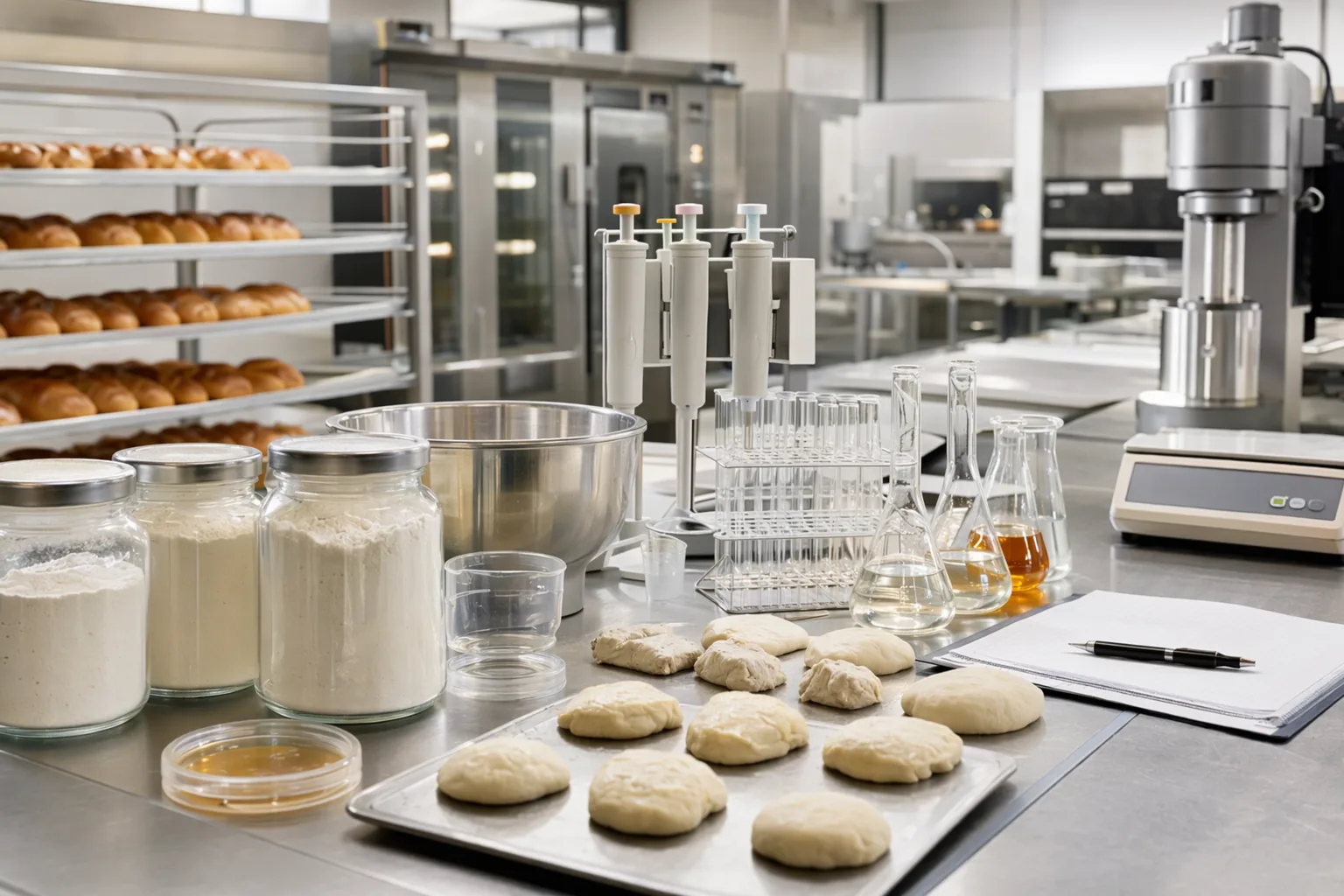
A practical buyer-focused guide to selecting, validating, and purchasing alpha amylase enzyme for bread, buns, rolls, crackers, and other baked goods.
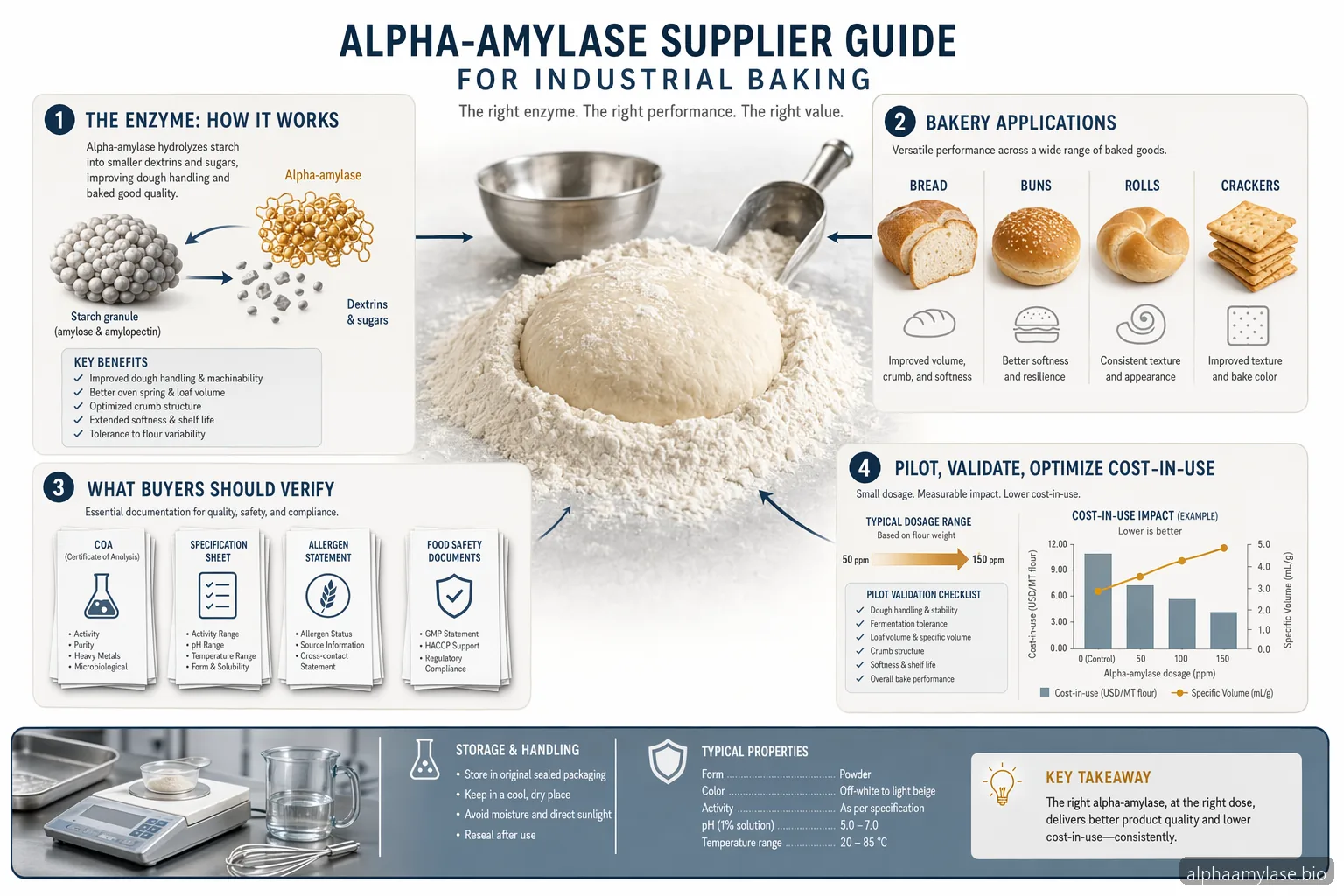
Why Alpha Amylase Matters in Baking
Alpha amylase is an enzyme protein that hydrolyzes starch into shorter dextrins and fermentable sugars. In baking, this supports yeast activity, improves dough handling in some systems, contributes to crust color, and can help maintain crumb softness over shelf life. Industrial buyers should treat alpha-amylase as a functional processing aid whose effect depends on flour damage, native amylase level, water absorption, proof time, oven profile, and formula sugar. Too little activity may give weak fermentation support and pale crust; too much can create sticky dough, gummy crumb, or slicing problems. For consistent production, the target is not the highest activity but the most predictable activity under your process conditions. A qualified alpha amylase supplier should help match enzyme type, activity unit, carrier, and format to your bakery line, whether you produce pan bread, hamburger buns, tortillas, crackers, or frozen dough.
Primary function: controlled starch breakdown • Common benefits: fermentation support, color, crumb texture • Main risk: over-dosing and excessive dextrin formation
Process Conditions and Dosage Starting Points
For baking applications, many commercial alpha amylase enzyme products are designed to work in dough systems around pH 4.5 to 6.5 and moderate processing temperatures before oven heat. Fungal alpha amylase is often selected where heat inactivation during baking is desired, while bacterial amylase may offer higher thermal tolerance and should be evaluated carefully to avoid residual activity issues. Starting dosage depends on declared activity, flour quality, and product format, but bakery trials often begin in the range of about 5 to 50 ppm enzyme preparation on flour weight, or according to the supplier’s activity-based recommendation. If a product is labeled with an activity such as alpha amylase 3000, confirm what method and unit definition are used; activity numbers are not always directly comparable between suppliers. Always run bench and pilot trials before changing plant-scale dosage.
Typical dough pH: about 4.5–6.5 • Trial dosage: commonly 5–50 ppm on flour weight • Confirm activity method before comparing offers • Reduce dosage if crumb becomes sticky or gummy
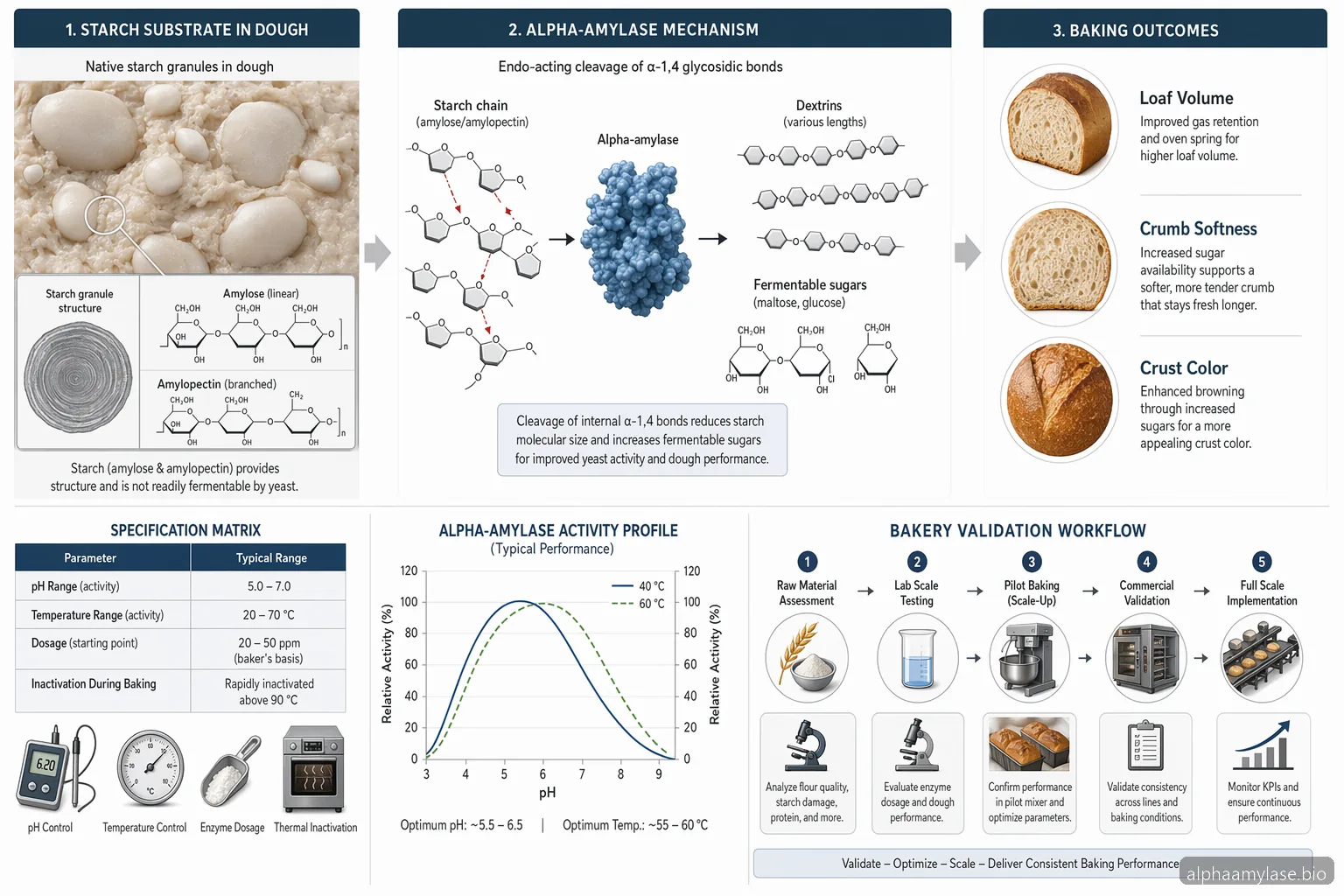
Documents Buyers Should Request
A reliable alpha amylase supplier should provide a complete technical and quality document set before commercial approval. The Certificate of Analysis should list batch number, enzyme activity, appearance, moisture or relevant physical parameters, microbiological limits where applicable, and release date. The Technical Data Sheet should describe product format, recommended dosage, handling, storage, shelf life, solubility or dispersion, activity definition, and suitable applications. The Safety Data Sheet is needed for worker handling, dust control, storage, spill response, and transport classification. Buyers should also request allergen information, GMO or non-GMO positioning where relevant, carrier composition, country of origin, traceability process, and regulatory suitability for intended markets. If a supplier claims a certification or quality system, request the current certificate directly rather than relying on a sales statement.
COA: batch activity and release data • TDS: dosage, storage, and application guidance • SDS: safe handling and transport information • Traceability: batch and raw material controls
Pilot Validation for Bakery Scale-Up
Pilot validation is essential because flour variation and line conditions can change enzyme performance. Start with a control formula, then test at least three alpha amylase levels around the supplier’s recommendation, such as low, target, and high dosage. Record dough absorption, mixing time, dough temperature, proof height, pH, bake loss, loaf volume, crumb grain, crust color, slicing performance, and sensory observations. For shelf-life targets, measure crumb firmness over several days using a consistent method, not only fresh-baked appearance. If the bakery uses frozen dough or par-baked products, include freeze-thaw stability and delayed baking in the validation plan. Scale-up should confirm feeder accuracy, premix uniformity, and enzyme dispersion. A successful trial defines an operating window, corrective actions, and a maximum dosage limit to prevent quality defects.
Run control, low, target, and high dosage trials • Measure crumb firmness over shelf life • Check feeder accuracy and premix uniformity • Define a maximum safe use level
Cost-in-Use and Supplier Qualification
The best alpha amylase purchase is rarely the lowest price per kilogram. Buyers should compare cost-in-use by calculating enzyme cost per metric ton of flour or finished product at the validated dosage. Include activity consistency, batch-to-batch variation, storage stability, lead time, minimum order quantity, technical support, and complaint response. A concentrated product may cost more per kilogram but less per production run if the activity is stable and dosage is lower. Supplier qualification should cover sample responsiveness, documentation quality, change-control notification, shelf-life management, packaging integrity, and ability to support repeatable production. For multi-site bakeries, confirm that the same specification can be supplied across regions. Strong suppliers help troubleshoot flour variation, over-fermentation, pale crust, or gummy crumb without pushing unnecessary enzyme load.
Compare cost per ton of flour, not only unit price • Review lead time, MOQ, and supply continuity • Check change-control and complaint procedures • Prioritize consistency and technical support
Technical Buying Checklist
Buyer Questions
Choose a supplier that can provide a representative sample, clear activity definition, COA, TDS, SDS, batch traceability, and practical bakery trial support. Ask for recommended dosage on flour weight, pH and temperature guidance, storage conditions, shelf life, and change-control policy. The supplier should help interpret pilot results such as crumb softness, crust color, proof performance, and any signs of gumminess.
A common screening range is about 5 to 50 ppm enzyme preparation on flour weight, but the correct dose depends on activity units, flour quality, formula, process time, and desired shelf-life effect. Start with the supplier’s recommendation, then run control, low, target, and high levels. Do not convert dosage between products unless the activity method and unit definition are comparable.
Bacterial amylase can be useful in some baking systems, but it may be more heat tolerant than fungal alpha amylase. That means residual activity can continue longer during baking if not properly selected and dosed. Buyers should validate crumb texture, slicing quality, and shelf-life performance before commercial use. If gumminess or sticky crumb appears, reduce dosage or evaluate a different enzyme profile.
In industrial enzyme sourcing, alpha amylase protein and alpha-amylase generally refer to the same functional enzyme class that breaks internal alpha-1,4 starch bonds. Commercial products are enzyme preparations, not pure laboratory proteins, and may include carriers or stabilizers. For purchasing, focus on declared activity, application performance, formulation compatibility, safety documentation, and batch consistency rather than wording differences.
Searches such as sirop alpha amylase, alpha amylase sirop, maxilase alpha amylase, or alpha amylase werte often relate to consumer, pharmaceutical, or diagnostic topics. Industrial bakery procurement is different. Buyers should specify food-processing alpha amylase enzyme for baking, request technical documentation, and validate performance in flour-based production. This page does not provide medical, supplement, or diagnostic advice.
Alpha-Amylase for Research & Industry
Need Alpha-Amylase for your lab or production process?
ISO 9001 certified · Food-grade & research-grade · Ships to 80+ countries
Frequently Asked Questions
How do I choose an alpha amylase supplier for baking?
Choose a supplier that can provide a representative sample, clear activity definition, COA, TDS, SDS, batch traceability, and practical bakery trial support. Ask for recommended dosage on flour weight, pH and temperature guidance, storage conditions, shelf life, and change-control policy. The supplier should help interpret pilot results such as crumb softness, crust color, proof performance, and any signs of gumminess.
What dosage of alpha amylase enzyme should a bakery start with?
A common screening range is about 5 to 50 ppm enzyme preparation on flour weight, but the correct dose depends on activity units, flour quality, formula, process time, and desired shelf-life effect. Start with the supplier’s recommendation, then run control, low, target, and high levels. Do not convert dosage between products unless the activity method and unit definition are comparable.
Is bacterial amylase suitable for bread and buns?
Bacterial amylase can be useful in some baking systems, but it may be more heat tolerant than fungal alpha amylase. That means residual activity can continue longer during baking if not properly selected and dosed. Buyers should validate crumb texture, slicing quality, and shelf-life performance before commercial use. If gumminess or sticky crumb appears, reduce dosage or evaluate a different enzyme profile.
What is the difference between alpha amylase protein and alpha-amylase?
In industrial enzyme sourcing, alpha amylase protein and alpha-amylase generally refer to the same functional enzyme class that breaks internal alpha-1,4 starch bonds. Commercial products are enzyme preparations, not pure laboratory proteins, and may include carriers or stabilizers. For purchasing, focus on declared activity, application performance, formulation compatibility, safety documentation, and batch consistency rather than wording differences.
Are sirop alpha amylase or alpha amylase sirop relevant for bakery buyers?
Searches such as sirop alpha amylase, alpha amylase sirop, maxilase alpha amylase, or alpha amylase werte often relate to consumer, pharmaceutical, or diagnostic topics. Industrial bakery procurement is different. Buyers should specify food-processing alpha amylase enzyme for baking, request technical documentation, and validate performance in flour-based production. This page does not provide medical, supplement, or diagnostic advice.
Related: Alpha Amylase for Baking Bread — Dough Conditioning and Shelf Life
Turn This Guide Into a Supplier Brief Request a baking alpha amylase sample, COA/TDS/SDS package, and pilot-trial dosage recommendation for your flour system. See our application page for Alpha Amylase for Baking Bread — Dough Conditioning and Shelf Life at /applications/alpha-amylase-bread-dough-conditioning/ for specs, MOQ, and a free 50 g sample.
Contact Us to Contribute