Alpha Amylase Baking Enzyme Market: Process Guide
Process guide for industrial alpha amylase enzyme baking buyers: conditions, dosage, QC, COA/TDS/SDS checks, pilots, and supplier qualification.
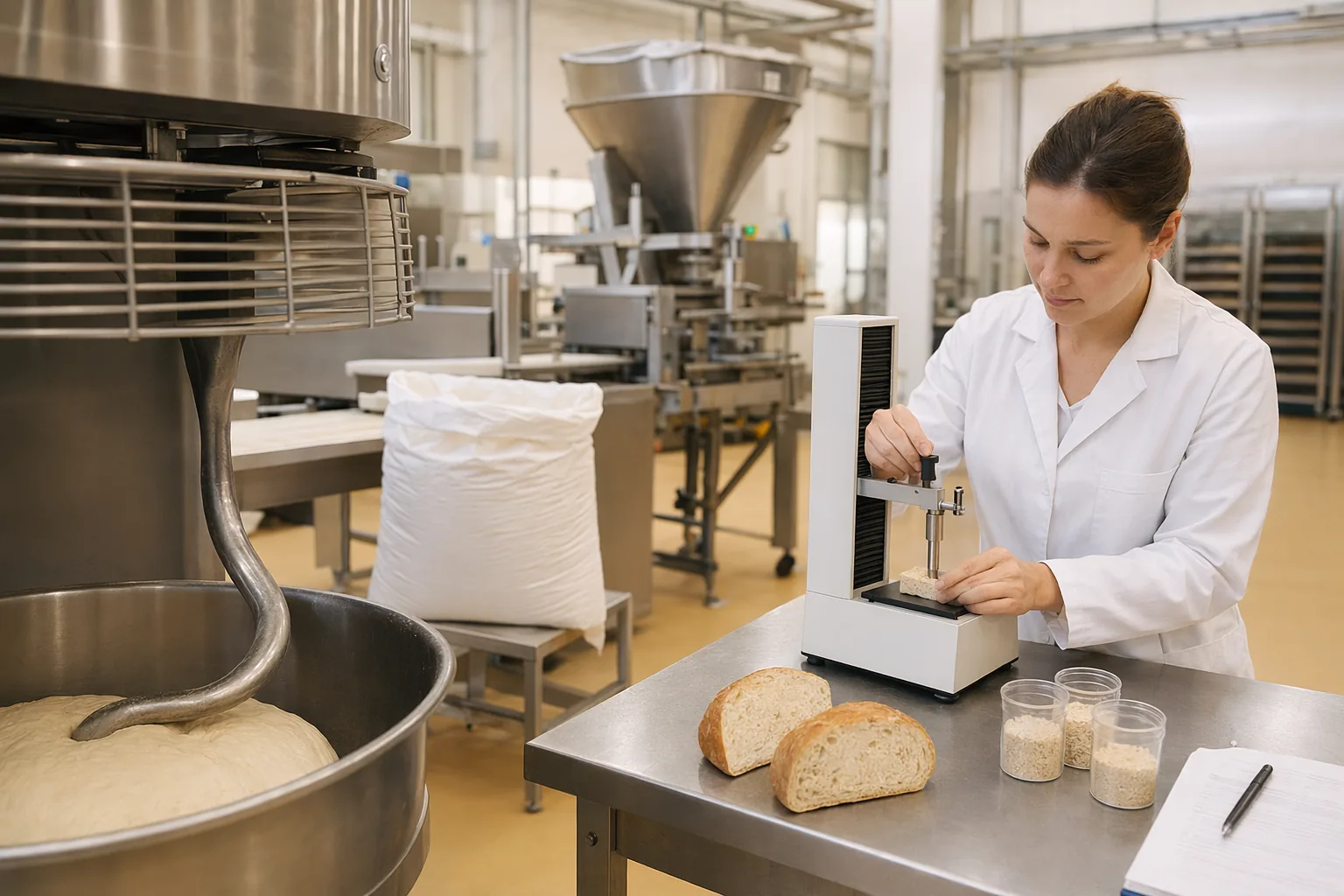
A practical B2B guide for bakeries, premix producers, and ingredient buyers selecting alpha amylase for dough handling, fermentation support, crumb softness, and cost-in-use control.
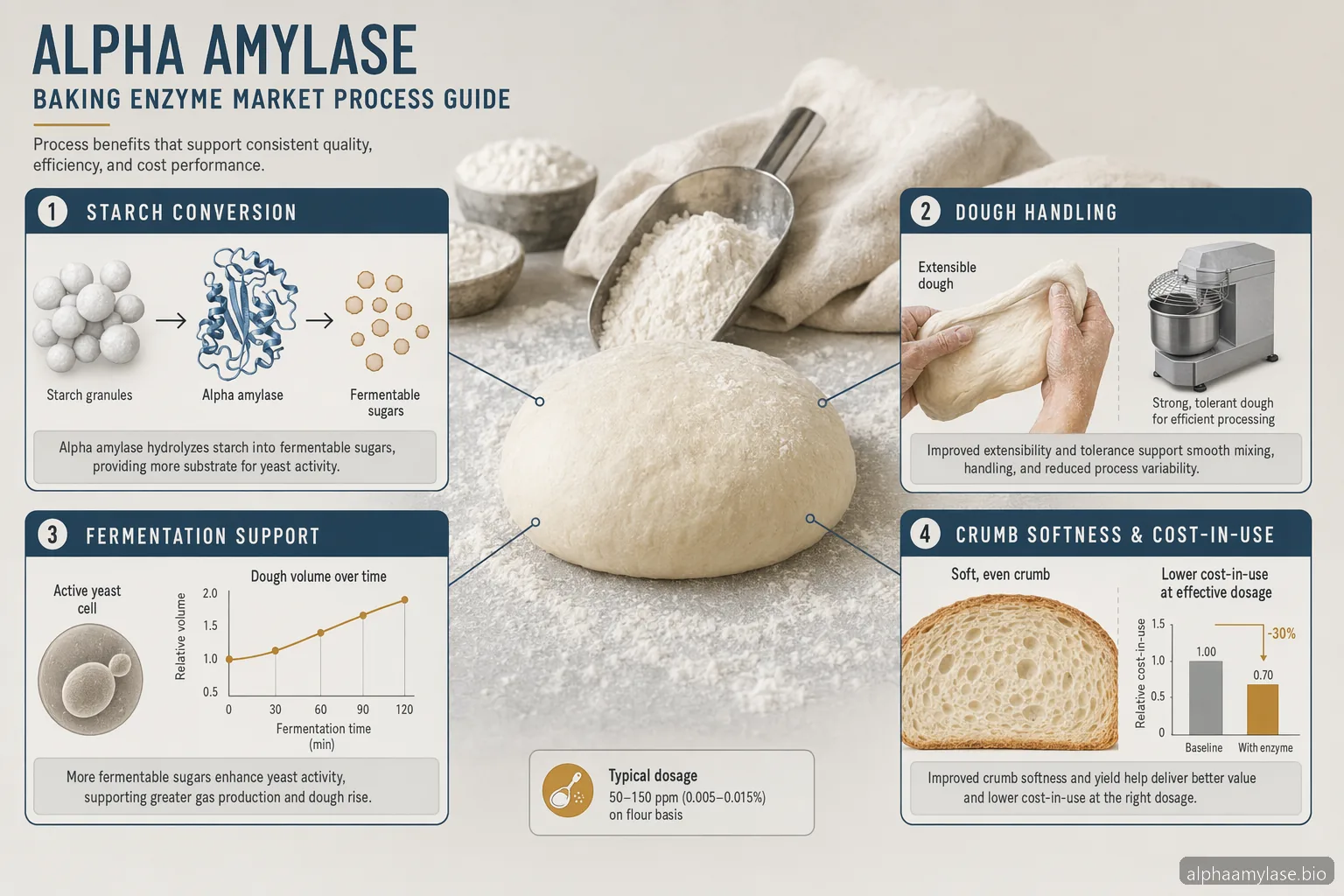
Market role of alpha amylase in baking
The alpha amylase baking enzyme market serves industrial bakeries, flour mills, improver blenders, frozen dough producers, and premix manufacturers that need consistent dough and finished-product quality. Alpha amylase, also written alpha-amylase, hydrolyzes internal alpha-1,4 starch bonds, producing shorter dextrins and maltose that can support yeast activity and crust color. In bread, buns, rolls, tortillas, and some sweet goods, the objective is usually controlled starch conversion, not excessive liquefaction. Buyers should evaluate the alpha amylase enzyme as a processing aid within a full formulation that may also contain fungal amylase, xylanase, lipase, emulsifiers, oxidants, or reducing agents. For B2B purchasing, the relevant question is whether a supplier can deliver repeatable activity, documentation, technical support, and lot-to-lot consistency at the bakery’s scale.
Primary value drivers: softness, volume, fermentation support, and process tolerance. • Common buyers: bakeries, flour treatment companies, improver houses, and premix blenders. • Selection should be based on application data, not only enzyme activity claims.
Process conditions and dosage considerations
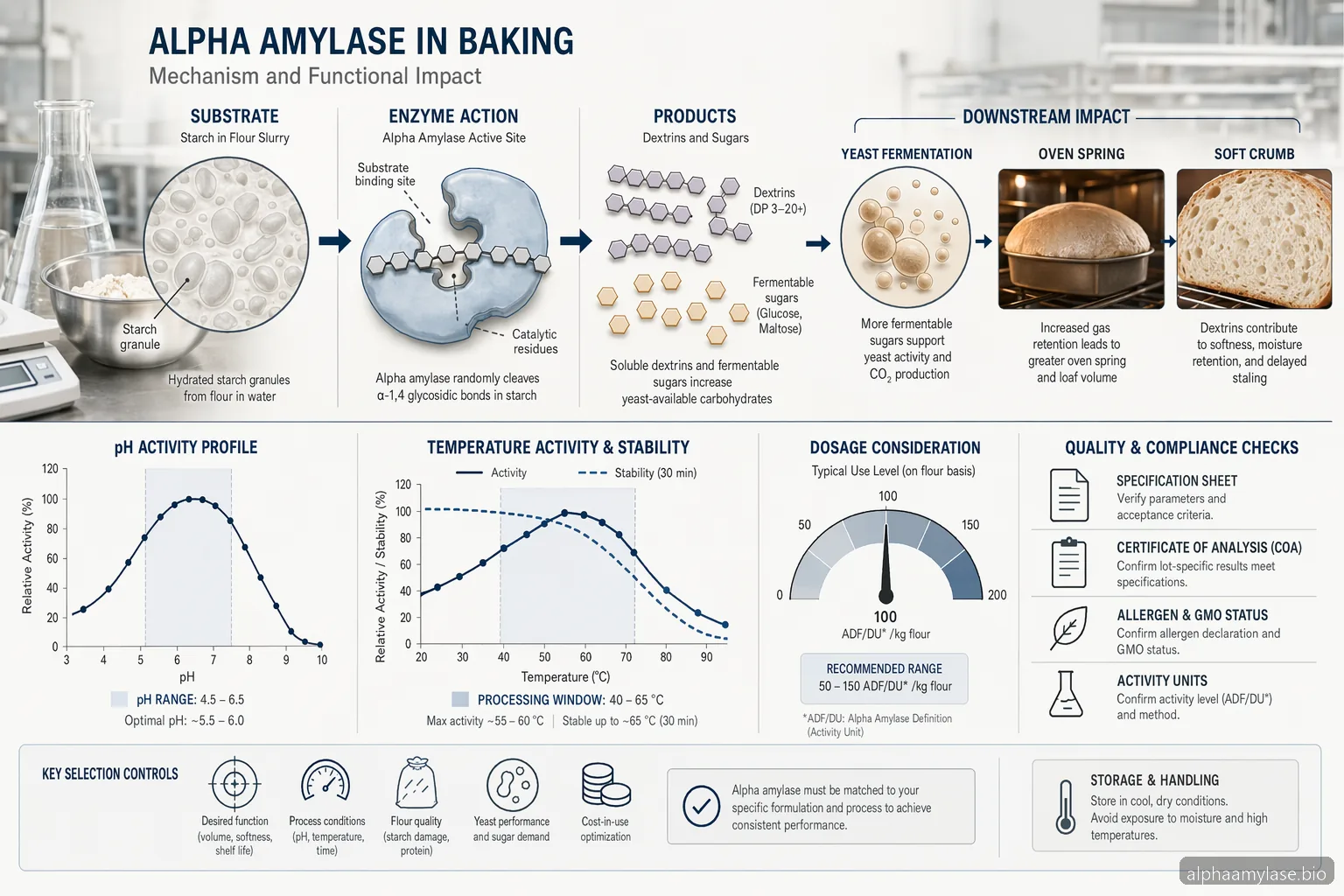
Industrial alpha amylase enzyme baking applications usually operate within dough pH around 5.0 to 6.2, depending on flour, sourdough level, yeast activity, and preservatives. Many baking alpha amylase products are active during mixing, floor time, proofing, and the early oven stage before heat inactivation. Temperature exposure may range from ambient mixing to proofing near 30 to 40 °C, then rapidly increase in the oven. Practical dosage is often expressed as enzyme product per flour weight, commonly in low gram-per-100 kg flour ranges or as activity units per kilogram flour. The correct band depends on enzyme source, declared units, flour falling number, damaged starch, formula sugar, and process time. Overdosing can create sticky dough, gummy crumb, excessive crust color, or slicing problems, so pilot trials should bracket low, target, and high levels.
Check dough pH, proof time, oven profile, and flour falling number before scale-up. • Run stepped dosage trials rather than a single recommended dose. • Confirm whether the enzyme is bacterial amylase, fungal amylase, or a blend.
Product specification documents buyers should request
A qualified alpha amylase supplier should provide a current certificate of analysis, technical data sheet, and safety data sheet for each commercial product. The COA should identify lot number, activity, test method, appearance, moisture or loss on drying where relevant, and microbiological parameters appropriate to the product format. The TDS should describe recommended application range, handling guidance, storage temperature, shelf life, carrier or diluent system, and compatibility notes. The SDS should support safe receiving, storage, dust control, personal protective equipment, and spill response. Buyers evaluating products described as alpha amylase 3000, alpha amylase protein, or similar activity-based names should verify the actual assay units and method, because enzyme units are not always interchangeable across suppliers. Documentation review is also important for allergen, GMO, kosher, halal, vegetarian, or regulatory-status questions when relevant to the buyer’s market.
Request COA, TDS, SDS, allergen statement, and activity method. • Verify units before comparing price, dosage, or performance. • Confirm shelf life and storage requirements under local warehouse conditions.
Pilot validation and QC checks
Pilot validation should reproduce the buyer’s real process as closely as possible, including flour source, mixing energy, water absorption, dough temperature, make-up equipment, proofing, baking, cooling, slicing, and packaging. A useful pilot plan compares a control against at least three dosage levels, with duplicate bakes when flour variability is high. Quality checks may include farinograph or mixograph response, dough stickiness, proof height, oven spring, loaf volume, crumb grain, crumb firmness over shelf life, moisture, water activity, crust color, and sensory screening. For pan bread and buns, crumb firmness at day 1, day 3, and day 7 can help quantify softness benefits. For high-speed lines, machinability and residue on belts may be as important as loaf score. The winning alpha amylase condition is the one that meets specification with margin, not necessarily the highest volume result.
Include a no-enzyme control and multiple dosage points. • Track finished-product quality through declared shelf life. • Record line behavior, not only lab measurements.
Cost-in-use and supplier qualification
Cost-in-use for alpha amylase should be calculated per tonne of flour or per thousand finished units, using validated dosage, yield impact, waste reduction, shelf-life performance, and any handling costs. A lower purchase price can be uneconomic if activity is inconsistent, dosage is higher, or technical support is limited. Supplier qualification should cover manufacturing traceability, lot reservation capability, lead time, minimum order quantity, packaging integrity, change-control communication, and responsiveness during trials or troubleshooting. Buyers importing enzyme products should confirm documentation language, customs descriptions, temperature exposure during transit, and local regulatory requirements. Inquiries using terms such as sirop alpha amylase or alpha amylase sirop should clarify whether the need is for a liquid enzyme format, starch syrup processing, or a baking improver application. Clear application data helps the supplier recommend a product without overpromising results.
Compare total cost per flour tonne, not only price per kilogram. • Qualify backup supply for critical bakery lines. • Ask for change notification procedures before approval.
Technical Buying Checklist
Buyer Questions
Alpha amylase converts part of the starch in flour into dextrins and fermentable sugars. In controlled amounts, this can support yeast fermentation, crust color, loaf volume, crumb softness, and shelf-life texture. The effect depends on flour damage, falling number, formula sugar, process time, and baking profile. It should be validated in the actual product and line conditions.
Bacterial amylase can be used in some bakery systems, but suitability depends on its heat stability, dosage, and desired effect. More heat-stable enzymes may continue acting longer in the oven, which can be useful or risky depending on the product. Buyers should compare bacterial amylase with fungal or maltogenic alternatives through pilot bakes, crumb testing, and line handling checks.
Compare suppliers using documented activity method, COA consistency, TDS clarity, SDS quality, technical support, traceability, lead time, packaging, and change-control practices. Price per kilogram is not enough because enzyme concentration and performance differ. Run the same formula and process with each candidate, then calculate cost-in-use based on validated dosage and finished-product quality.
There is no universal dosage because products use different activity units and enzyme sources. A practical approach is to request the supplier’s recommended range, then run low, target, and high trials based on flour weight or activity units per kilogram flour. Watch for sticky dough, gummy crumb, excessive color, or slicing problems, which can indicate over-treatment.
Not by themselves. Names such as alpha amylase 3000 may refer to a supplier’s activity grade, but the unit method must be confirmed. Phrases such as alpha amylase sirop or sirop alpha amylase may indicate liquid format, syrup processing, or a translated purchasing query. Clarify the intended application, process conditions, and required documentation before comparing offers.
Alpha-Amylase for Research & Industry
Need Alpha-Amylase for your lab or production process?
ISO 9001 certified · Food-grade & research-grade · Ships to 80+ countries
Frequently Asked Questions
What does alpha amylase do in industrial baking?
Alpha amylase converts part of the starch in flour into dextrins and fermentable sugars. In controlled amounts, this can support yeast fermentation, crust color, loaf volume, crumb softness, and shelf-life texture. The effect depends on flour damage, falling number, formula sugar, process time, and baking profile. It should be validated in the actual product and line conditions.
Is bacterial amylase suitable for bakery applications?
Bacterial amylase can be used in some bakery systems, but suitability depends on its heat stability, dosage, and desired effect. More heat-stable enzymes may continue acting longer in the oven, which can be useful or risky depending on the product. Buyers should compare bacterial amylase with fungal or maltogenic alternatives through pilot bakes, crumb testing, and line handling checks.
How should buyers compare alpha amylase suppliers?
Compare suppliers using documented activity method, COA consistency, TDS clarity, SDS quality, technical support, traceability, lead time, packaging, and change-control practices. Price per kilogram is not enough because enzyme concentration and performance differ. Run the same formula and process with each candidate, then calculate cost-in-use based on validated dosage and finished-product quality.
What is a safe starting dosage for alpha amylase in baking?
There is no universal dosage because products use different activity units and enzyme sources. A practical approach is to request the supplier’s recommended range, then run low, target, and high trials based on flour weight or activity units per kilogram flour. Watch for sticky dough, gummy crumb, excessive color, or slicing problems, which can indicate over-treatment.
Do terms like alpha amylase 3000 or alpha amylase sirop define performance?
Not by themselves. Names such as alpha amylase 3000 may refer to a supplier’s activity grade, but the unit method must be confirmed. Phrases such as alpha amylase sirop or sirop alpha amylase may indicate liquid format, syrup processing, or a translated purchasing query. Clarify the intended application, process conditions, and required documentation before comparing offers.
Related: Alpha Amylase for Baking Bread — Dough Conditioning and Shelf Life
Turn This Guide Into a Supplier Brief Request a baking enzyme specification review, pilot trial plan, and cost-in-use comparison for your flour system. See our application page for Alpha Amylase for Baking Bread — Dough Conditioning and Shelf Life at /applications/alpha-amylase-bread-dough-conditioning/ for specs, MOQ, and a free 50 g sample.
Contact Us to Contribute