Thermostable Alpha-Amylase for Fast Starch Breakdown
Boost mash liquefaction, improve syrup yields, and stabilise starch conversion with Bacillus-derived, high-activity alpha-amylase for industrial operations.
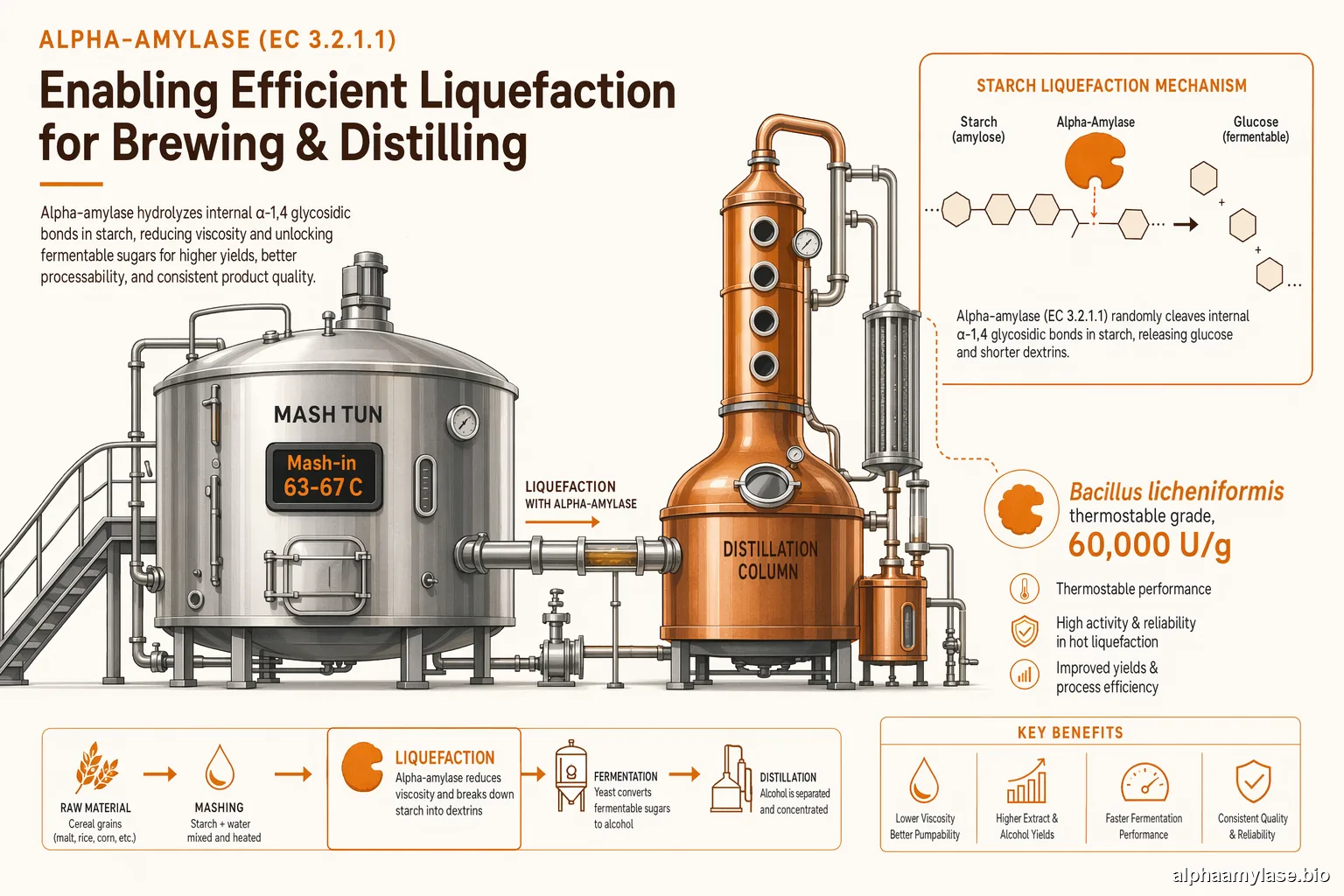
Brewing, syrup production, and starch-processing plants face a similar challenge: controlling viscosity while converting gelatinised starch into fermentable sugars efficiently. Without effective liquefaction, mash flow suffers, conversion slows, and downstream yields fluctuate. For industrial buyers, this can mean increased energy use, longer process times, and inconsistent quality. Bacillus subtilis / Bacillus licheniformis–derived alpha-amylase is engineered for reliable performance under high-heat, variable-pH conditions typical of large-scale operations. It hydrolyses α‑1,4‑glycosidic bonds in gelatinised starch, producing shorter dextrins and soluble sugars that are easier to handle and process. Operating at an optimal pH of 5.5–7.0 and temperatures between 70 °C and 95 °C, it maintains activity in mash tanks, jet cookers, and continuous liquefaction systems. For procurement and technical teams, the benefits translate directly into operational gains: lower mash viscosity, faster liquefaction, smoother filtration, improved fermentability, and predictable viscosity control in non-food sectors. In brewing and distilling, this means better wort flow and more consistent fermentations. In syrup manufacturing, it sets up starch for efficient saccharification to glucose or fructose. In ethanol production, it streamlines high-solids mash handling while reducing energy demand. Textile and paper processors value its ability to remove or modify starch cleanly without damaging fibres or coatings. With activity grades from 20,000–40,000 U/g (and a thermostable option at 60,000 U/g), available in powder or liquid form, this alpha-amylase is a versatile, food‑grade solution ready for integration into diverse industrial workflows.
Brewing & Distilling
Liquefies gelatinised starch in mash at elevated temperatures (85–95 °C), reducing viscosity for improved pumpability and heat transfer. Supports malted and adjunct-heavy recipes, enabling consistent extract release and fermentation efficiency across beer, whiskey, and other distillates.
Starch Liquefaction for Syrups
Acts as the first-stage enzyme for producing glucose or fructose syrups, converting raw starch slurry into soluble dextrins. Performs reliably in high-heat processing, ensuring smoother downstream saccharification and filtration with reduced risk of process interruptions.
Ethanol Production
Handles high-solids liquefaction of corn, cassava, or other starch feedstocks at industrial temperatures and pH. Lowers viscosity, improves heat transfer, and enhances conversion efficiency before glucoamylase completes saccharification for fuel ethanol output.
Textile Desizing and Paper Sizing
Removes or modifies starch-based sizes and coatings without harsh chemicals. In textiles, enables even dye uptake; in paper manufacturing, controls coating viscosity for improved printability and surface performance.
| Parameter | Value |
| Activity range | 20,000 – 40,000 U/g (thermostable grade: 60,000 U/g) |
| Optimal pH | 5.5 – 7.0 |
| Optimal temperature | 70 °C – 95 °C |
| Form | Light brown powder or amber liquid |
| Shelf life | 12 months (sealed, cool, dry place) |
| Packaging | 25 kg drums (powder) / 30 kg jerricans (liquid); MOQ 25 kg |
Frequently Asked Questions
What does alpha-amylase do in industrial processing?
Alpha-amylase hydrolyses α-1,4 bonds in gelatinised starch, reducing viscosity and producing shorter dextrins. This makes slurries more manageable and accessible to downstream enzymes, improving control in brewing, syrup production, ethanol manufacturing, and fibre or paper treatments. The result is shorter process times, improved handling, and more predictable conversion.
What are the optimal operating conditions for this enzyme?
This Bacillus-derived grade works best at pH 5.5–7.0 and 70 °C to 95 °C, making it well suited for brewing mash tuns, starch jet cookers, and ethanol liquefaction systems. Thermostable options are available for processes involving extended high-heat exposure where standard enzymes might lose activity.
How is alpha-amylase applied in brewing?
In brewing and distilling, it is dosed into mash to break down gelatinised starch, reducing viscosity and preparing the substrate for saccharifying enzymes. This improves wort flow, extract yield, and fermentation consistency, especially in recipes with high adjunct content or where process repeatability and throughput are priorities.
What dosage should industrial users expect?
Dosage depends on starch type, solids content, and process design. Brewing and distilling may use 0.05–0.2 g/L (powder) or 0.1–0.3 mL/L (liquid); industrial liquefaction often uses 0.2–0.6 kg per tonne of dry starch equivalent. Final rates should be confirmed with trials under actual plant conditions.
Can one enzyme cover both syrup and ethanol production?
Yes. The same liquefaction function—breaking down starch into soluble dextrins—serves both syrup manufacturing and ethanol production. Choosing a single alpha-amylase platform can streamline procurement, reduce inventory complexity, and ensure consistent performance across multiple starch-processing lines.
Specify the right alpha-amylase grade
For manufacturers, distributors and resellers. Tell us (1) the product: grade or application, process temperature and pH if you know them; (2) the quantity: per order or per month, powder or liquid; (3) the destination country and preferred delivery terms. We reply with a recommended grade, pack size and a quotation. Price, lead time and freight are quoted per order. We will advise on powder vs liquid and standard vs thermostable grade, ship a free 100 g sample with COA, and quote bulk pricing within 24 hours.
Request a Quote